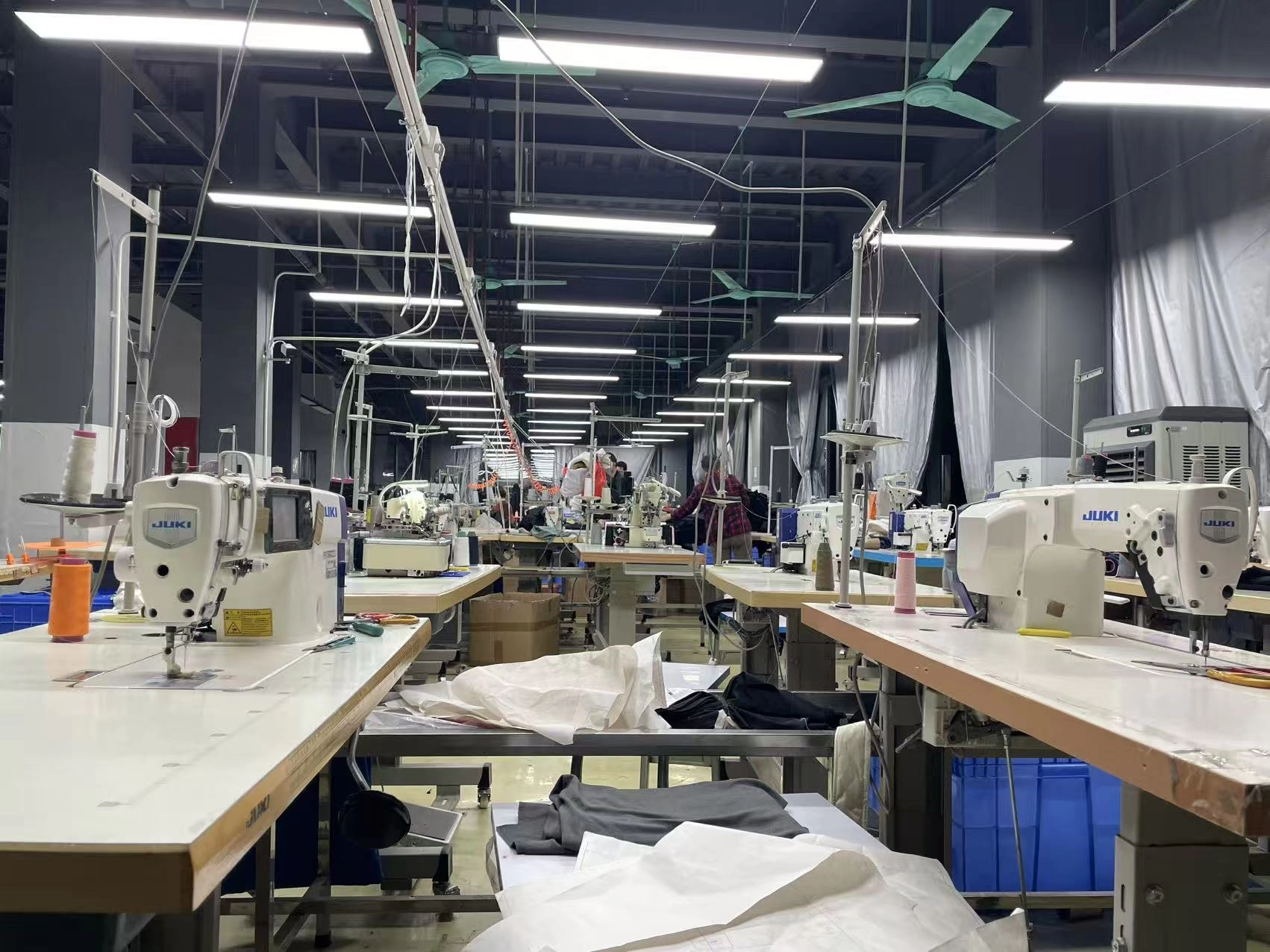
Fabric and Construction Selection for Private Label Apparel
Fabric choice decides more of your landed cost, your return rate and your repeat-order potential than any other decision in a private label programme. This guide walks through the specification points that actually move those three numbers.
On this page
Fabric drives the unit cost — not the sewing line
In most apparel categories, fabric accounts for somewhere between 45% and 65% of the ex-works cost of a garment. Sewing labour, which buyers often focus on during negotiation, typically sits between 15% and 30%. The practical consequence is that a 10% shift in fabric price moves the total cost several times more than an equivalent shift in labour.
This is why the fabric specification should be settled before the price conversation, not after. When a buyer asks for a lower price without touching the specification, the only place a factory can find money is in the fabric — and that is exactly where quality erosion is hardest to see in a photograph.
Where to look when a quote is high: fabric consumption per garment first, GSM second, decoration colour count third. Those three account for most of the spread between two honest quotations for the same style.
Knit or woven: choosing the right family
The first specification decision is the fabric family, because it constrains everything downstream — pattern, machinery, seam type, and how the garment ages.
| Property | Knitted fabric | Woven fabric |
|---|---|---|
| Structure | Interlooped yarns; stretches | Interlaced warp and weft; stable |
| Typical garments | T-shirts, hoodies, polos, leggings, activewear | Shirts, trousers, jackets, dresses, outerwear |
| Seam type | Overlock, flatlock, coverstitch | Plain, French, flat-felled |
| Fit behaviour | Recovers; tolerates body movement | Holds shape; requires accurate grading |
| Main failure mode | Pilling, shrinkage, seam grin | Seam slippage, seam pucker, fraying |
| Decoration fit | Screen print, embroidery, sublimation | Embroidery, patches, heat transfer |
A common early error is specifying a knit garment with woven construction expectations — asking for a French seam on jersey, for example, or requesting a crisp tailored shoulder on a fleece. Both are possible, both cost more, and neither performs as the buyer imagines.

GSM, composition and the substitution trap
GSM (grams per square metre) is the single most useful fabric number for a buyer, because it correlates directly with weight, opacity, drape and cost. Two fabrics with identical composition and different GSM behave like different materials.
| Range | Typical use | Buyer note |
|---|---|---|
| 120–160 GSM | Lightweight tees, summer tops | Check opacity on light colours before approving |
| 160–200 GSM | Standard T-shirts, polo shirts | The mainstream retail weight for cotton jersey |
| 200–280 GSM | Heavyweight tees, sweatshirting | Premium handfeel; watch shrinkage at higher weights |
| 280–400 GSM | Hoodies, fleece, winter knits | Confirm recovery after wash, not just dry handfeel |
Composition must be stated in percentages, not words. "Cotton blend" is not a specification. Percentages determine shrinkage behaviour, colour-fastness, pilling resistance and how the garment takes decoration.
The substitution trap. When a supplier proposes a lower price "with the same handfeel", ask for the GSM and composition in writing before accepting. A 180 GSM jersey substituted at 160 GSM looks similar on the hanger and fails noticeably after five washes — by which time the goods have shipped.
Two further fabric variables are worth confirming in writing on any programme that will reorder:
- Shrinkage allowance — ask for the tested figure and the allowance built into the pattern. Untreated cotton jersey can shrink several percent in the length direction.
- Colour-fastness basis — the test standard and rating the supplier works to, particularly for dark shades and prints destined for markets with labelling requirements.
Construction details buyers should specify
Construction is where an adequate garment and a durable garment diverge. These are the points worth naming explicitly in the tech pack, because a factory will otherwise build to its own default.
Seams and stitches
- Seam type at each location — side seams, shoulder, armhole, hem, and any seam carrying load
- Stitch density — stitches per inch or centimetre; higher density is not automatically better, but it must be consistent
- Reinforcement at pocket mouths, fly openings, and any point that will be pulled repeatedly
- Bartacks at stress points such as belt loops and pocket corners
Fit and grading
- Base size block — state which size the pattern is developed on
- Grading increments — how measurements step between sizes
- Tolerances — per POM, because zero tolerance is not achievable and forces inspection disputes
Finishing
- Trimming and thread ends — the most visible quality signal in retail
- Pressing and setting — determines how the garment presents on the hanger
- Label placement — exact position in centimetres from the reference point
Specify tolerances explicitly. A measurement chart without a tolerance column guarantees a dispute at inspection, because both sides will apply their own default. Agreeing the tolerance in writing before sampling is what makes a bulk inspection pass or fail objectively.
Decoration methods and their durability
Decoration choice is a durability decision as much as a design one. The same artwork behaves very differently across methods, and the print colour count often moves the unit cost more than the garment construction does.
| Method | Best suited to | Durability considerations |
|---|---|---|
| Screen print | Bold, low-colour graphics on knits | Cost rises per colour; cracks if over-stretched or under-cured |
| Embroidery | Logos, monograms, structured fabrics | Very durable; dense designs can distort light jersey |
| Heat transfer | Photographic, multi-colour artwork | Fast application; adhesion depends on correct temperature |
| Sublimation | All-over prints on polyester | No added handfeel; requires polyester content to bond |
| Patches and appliqué | Heritage and streetwear detailing | Durable; adds weight and requires secure stitching |
Two specification points prevent most decoration failures. First, state the artwork size and placement with dimensions rather than a visual impression. Second, confirm the curing or bonding parameters are appropriate for the fabric — a heat transfer that performs well on cotton can fail on a coated or synthetic face.
Inspection: the defects that cause returns
Most returns are not caused by dramatic failures. They cluster around a small number of recurring issues, and each one can be addressed at a defined stage of production.
- Measurement deviation beyond tolerance — caught at in-line measurement, not final inspection
- Colour variation between dye lots — controlled by cutting from a single lot per colourway
- Seam slippage or grin — a construction and fabric compatibility issue
- Shrinkage after wash — a fabric-preparation issue, resolved before cutting
- Decoration cracking or peeling — an application-parameter issue
- Untrimmed thread ends and poor pressing — a finishing discipline issue
Inspect in-line, not only at the end. A final audit finds problems after the entire order is built. In-line inspection at defined checkpoints — after cutting, after assembly, after finishing — is what allows a factory to correct a drift before it multiplies across thousands of units.
FAQ
What GSM should I choose for a T-shirt?
For mainstream retail, 160–200 GSM cotton jersey is the standard range. Move to 200–280 GSM if you are positioning the product as heavyweight premium, and confirm shrinkage performance at the higher weights.
Can you match a fabric from a sample I send?
Yes. Send the physical sample and the factory will identify composition and estimate GSM, then propose the closest available mill quality or a custom development. Confirm the final specification in writing before bulk.
Is higher stitch density always better?
No. Excessively tight stitching can perforate and weaken the fabric, particularly on lightweight knits. What matters is a density appropriate to the fabric and applied consistently across the order.
Do you handle eco-friendly materials?
Yes. Our R&D team works with recycled and lower-impact fibre options alongside conventional qualities. Certification requirements should be stated up front, because they affect which mills can be used.
How do I avoid colour mismatch between reorders?
Approve a physical colour standard and retain it. Reorders should be matched against the retained standard and the original dye lot reference, which is why keeping the approved sample is worth the effort.
Need help specifying your fabric?
Send us the garment you have in mind — a sample, a reference photo or a full tech pack. Our team in Dongguan will come back with the fabric options that fit your target cost and your quality floor, plus the construction points worth locking down before sampling.
Email Apparel [email protected] or call +44 7892864589.