How to Vet an Apparel Manufacturer Before You Place an Order
Choosing the wrong garment supplier is the most expensive mistake in apparel sourcing, and it is also the one buyers spend the least time on. Price is easy to compare, so it gets compared; capability, process control and honesty are harder to measure, so they get assumed. This guide sets out what to ask for, what to check, and which answers predict a bad order long before it happens.
On this page
- Why vetting matters more than price
- Factory, trading company or agent: who you are actually talking to
- Evidence to request before you commit
- Matching capability to your order
- The sample as a test, not a preview
- What to look at if you visit, and what to ask if you cannot
- Red flags that predict a bad order
- A supplier scorecard you can reuse
- Vetting checklist
- FAQ
Why vetting matters more than price
An apparel order has a long tail. The quotation is signed in month one, production happens in month two or three, goods arrive in month four, and the true cost of the decision only becomes visible when the garments reach a customer. A supplier who is honest, organized and appropriately sized for your order will absorb the small problems that every order produces. A supplier who is none of those things will pass every problem on to you.
The cost of a poor choice rarely appears as a higher unit price. It appears as a shipment that arrives three weeks late and misses a season, a size grading error that affects one size across the whole run, a colour that does not match the approved sample, or a supplier who disappears once the deposit has cleared. None of those are visible in a price comparison, and all of them are detectable in advance with a few structured questions.
Vet on process, not on promises. Every supplier will tell you they care about quality. The distinguishing question is what they do when a defect is found, who does it, and what documentation exists afterwards. A supplier with a defined answer is a supplier with a system.
Factory, trading company or agent: who you are actually talking to
The first thing to establish is the identity of the entity you are dealing with, because it determines who controls production and who carries responsibility when something goes wrong. All three models are legitimate; the mistake is not knowing which one you have chosen.
| Model | What it means | Advantages | What to watch |
|---|---|---|---|
| Direct factory | You contract with the manufacturer that owns the production lines | Direct control of scheduling, easiest to visit, clearest accountability | Narrower capability; may not cover every category you need |
| Trading company | You contract with a company that places work with one or more factories | Wider category coverage, one point of contact, easier small orders | Less visibility of the actual line; quality depends on which factory was chosen |
| Sourcing agent | You pay a fee to someone who finds and manages factories on your behalf | Useful for complex multi-category programmes | Your contract is with the agent, not the maker; confirm who is liable for defects |
| Factory plus supply chain partner | A company that owns or operates production and coordinates materials and logistics | Category breadth with consolidated responsibility | Ask specifically which production sites are used and who inspects them |
Two questions clarify the position quickly. Ask which legal entity will appear on the contract, the invoice and the shipping documents — they should match. Then ask where the goods will physically be made, and whether you may inspect that site. A supplier who answers both without hesitation is either a factory or an unusually well-organized partner. A supplier who deflects the second question is telling you something. Once the contract question is settled, the next document to prepare is the brief itself, which is covered in our technical pack guide.
Evidence to request before you commit
Requesting documents is not distrust; it is how you shorten the list. A supplier who can produce a coherent set quickly is demonstrating the same record-keeping that will protect your order later. Ask for the items below in one message rather than one at a time, and note how long the reply takes.
| What to request | What it tells you |
|---|---|
| Business registration details for the contracting entity | Who you are actually contracting with, and whether the name matches the bank details |
| Production site address and a statement of what is made there | Whether the category you need is genuinely made in-house |
| Category list and typical order ranges | Whether your order is a comfortable fit or an experiment |
| Documented quality control process, from incoming material to final inspection | Whether quality is a system or an intention |
| Sample photographs of comparable work, with the client's identity removed | Real evidence of the construction you are buying |
| Names of the markets normally served | Whether they understand your destination's requirements |
| Payment terms, sample policy and standard lead times in writing | Whether the commercial terms are stable or improvised |
Read the answers for coherence, not for completeness. A supplier whose stated category list, sample photographs and production address all point to the same kind of work is credible. A supplier whose samples are excellent but whose stated capability drifts from message to message is a risk, however good the price.
Matching capability to your order
Capability is not a single ladder from bad to good. The right supplier for a fifty-piece pilot and the right supplier for a five-thousand-piece programme are often different companies, and a large factory that takes your small order reluctantly will serve you worse than a smaller one that wants it.
Four dimensions decide fit, and each should be checked against your own plans rather than in the abstract.
- Category match — a factory that excels at knit tops may be mediocre at structured outerwear. Ask which categories represent the bulk of their output, not which ones they can produce.
- Order size range — ask for the range they are comfortable with, and where your volume sits inside it. Being at the small end of a large factory's range means your order waits.
- Complexity match — decoration, linings, technical fabrics and multi-panel construction each add process steps. Confirm they are routine rather than occasional.
- Growth headroom — if you intend to scale, ask what volume they could support next season. Switching suppliers mid-growth is expensive.
The honest question to ask is what share of their capacity your order would represent. A supplier for whom you are a meaningful customer behaves differently from one for whom you are a rounding error, and that difference is worth more than a few percent on the unit price.
The sample as a test, not a preview
Buyers treat the counter-sample as a preview of the product. It is more useful as a test of the supplier, because it is the first piece of work you receive and everything you observe about how it was produced is evidence about the order that follows.
Watch four things beyond whether the garment looks right. How the brief was interpreted — did they follow the specification, or improve it without telling you? Both happen, and only the second needs a conversation. What was documented — did the sample arrive with a measurement chart, or only a garment? A supplier who sends measurements unprompted is measuring production too. How corrections were handled — a second round should be faster and more precise than the first, not louder. And whether the promised date held — a sample three days late for no stated reason is a useful warning about the bulk order.
Sample on the real thing. Wherever possible, sample the style you actually intend to order in the fabric you actually intend to use. A sample made in a convenient substitute fabric tests nothing about the material, and most of the surprises in bulk production come from material rather than from pattern.
What to look at if you visit, and what to ask if you cannot
A factory visit is the highest-value hour in the whole sourcing process, provided you look at the right things. Production machinery is not the interesting part; process discipline is.
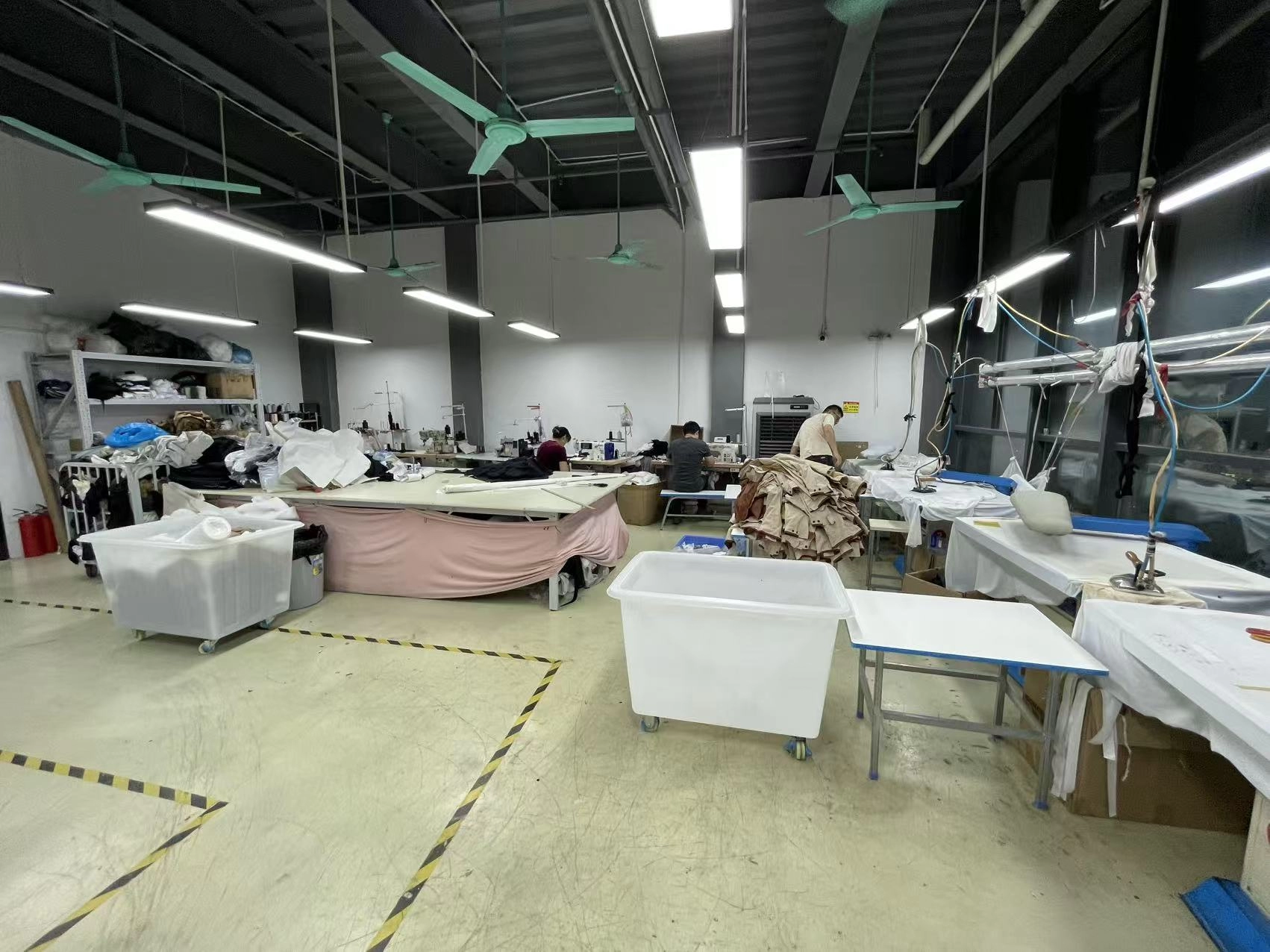
Look at the cutting floor, where errors originate and where fabric is consumed. Look at the in-line inspection station and the records kept there, because a factory that inspects only at the end is finding defects when they are most expensive. Look at the finishing and packing area, where the cartons your goods will travel in are made up, and check whether carton specification is being followed. And look at what is on the lines — the garments being made tell you what the factory is really good at, more honestly than any brochure.
If you cannot visit, four substitutes cover most of the ground. Ask for dated photographs of the production area, which are quick to supply and hard to fake convincingly in sequence. Commission a third-party inspection at the pre-shipment stage, which also verifies the site exists and matches the stated address. Ask for the name of an existing customer in your region whom you may contact. And place a small first order before a large one, which is the most reliable test available and the reason pilots exist.
Red flags that predict a bad order
No single item on this list is fatal. Two or three together, particularly if they concern communication or documentation, reliably predict a difficult order.
- Vague answers about production capacity — no clear statement of lines, monthly output or the share of capacity your order represents
- Reluctance to name the production site — or an address that changes between documents
- A different entity on the contract and the bank details — a straightforward payment risk, and a simple question to ask
- Quotations that move without a specification change — the number is being estimated rather than costed
- Unwillingness to state a production start week — a total lead time with no schedule behind it
- No documented quality process — quality described as a promise rather than as steps with records
- Pressure to skip the sample — the sample is the cheapest way to find out whether the brief was understood
- Slow or evasive answers to written questions — the same behaviour will appear when a shipment is late
- A price far below every other quotation — something in the specification is not what you think it is
A supplier scorecard you can reuse
Score every candidate on the same five dimensions, and keep the sheet. The value is not the total; it is being able to see, two seasons later, which dimension predicted the outcome.
| Dimension | What you are scoring | Evidence to look for |
|---|---|---|
| Capability fit | Category, complexity and order size against your needs | Comparable samples, stated output range, capacity share |
| Process control | Incoming, in-line and final inspection with records | A named QC process and dated production photographs |
| Communication | Speed, clarity and honesty of written replies | Answers to a multi-part question, in one reply, without prompting |
| Commercial clarity | Stable terms, matching entities, stated schedule | A written quotation with Incoterm, production week and payment terms |
| Sample performance | Brief interpretation, measurement chart, date held | The sample itself and a comparison against the specification |
Vetting checklist
- Legal entity identified, and consistent across contract, invoice, shipping documents and bank details.
- Production site named, with a statement of what is actually made there.
- Category list and order size range checked against your own programme.
- Documented quality process obtained, covering incoming material through final inspection.
- Sample photographs reviewed for real construction quality rather than styling.
- Destination markets confirmed, so packaging and documentation requirements are understood.
- Counter-sample ordered in the real fabric, and used as a test of process as well as product.
- Third-party inspection or a factory visit arranged for the first bulk order.
- Production start week and shipping week requested in the order confirmation.
- Scorecard completed and filed, so the next season's choice takes minutes rather than weeks.
FAQ
Should I choose a factory or a trading company?
Both work. A direct factory gives you closer control of scheduling and clearer accountability, which suits buyers whose categories are narrow and whose volumes are steady. A trading company or supply chain partner can cover more categories and handle smaller, more varied orders, which suits buyers building a range across several product types. The question to answer in both cases is who owns the production line, and who is responsible to you when something goes wrong.
What documents should I ask for before the first order?
Business registration details for the contracting entity, the production site address, a category and capacity statement, a documented quality control process covering incoming material and final inspection, sample photographs of comparable work, the markets normally served, and written payment terms and lead times. Ask for them all in one message and note how quickly and coherently they arrive, because that reply is itself evidence.
Is a factory visit necessary?
Not strictly, but it is the highest-value hour available. If you cannot travel, four substitutes cover most of the ground: dated photographs of the production area, a third-party pre-shipment inspection, a reference customer you may contact, and a small pilot order before a large one. The pilot is the most reliable test of all, which is why it is worth designing one even when a full visit is possible.
How many suppliers should I keep in play?
Two approved suppliers for your main category and a third under evaluation is a workable balance for most small and mid-sized brands. Sole-sourcing leaves you exposed to a single factory's capacity problems; maintaining five or six relationships dilutes the volume you place with each, which weakens your position at exactly the moment you need flexibility.
What is the most reliable warning sign?
Slow, partial or evasive answers to written questions. Nearly every serious problem in apparel sourcing is a communication problem before it becomes a production problem, and a supplier who cannot answer three questions clearly in one reply will not handle a late fabric shipment clearly either. Price anomalies and documentation mismatches matter too, but communication is the earliest predictor and the cheapest to test.
Start with the questions, not the price.
Apparel Manufacturing manufactures full-category apparel from Dongguan, Guangdong — men's, women's, kids' and activewear — with OEM/ODM support from design through delivery and a documented quality control process spanning incoming material to final inspection. Send us your vetting questions along with your category and target volume, and our team will answer them in writing.
Email Apparel [email protected] or reach the sales desk on +44 7892864589. More sourcing guidance sits in our apparel buying guides.